Irvington, New Jersey
The InnocentIrvington, New Jersey, is the economically strained home Matt Hunter chooses after prison, a city whose neglected beer-bottle water tower and disintegrating neighborhood give physical form to his uneasy, gradual return to ordinary life. The place is neither simply a refuge nor merely a backdrop: Matt’s attachment to its streets grows from the same difficulty that keeps him from returning to the suburbs, making the city’s worn condition part of the story’s account of reintegration and belonging.
The Bottle and the Neighborhood
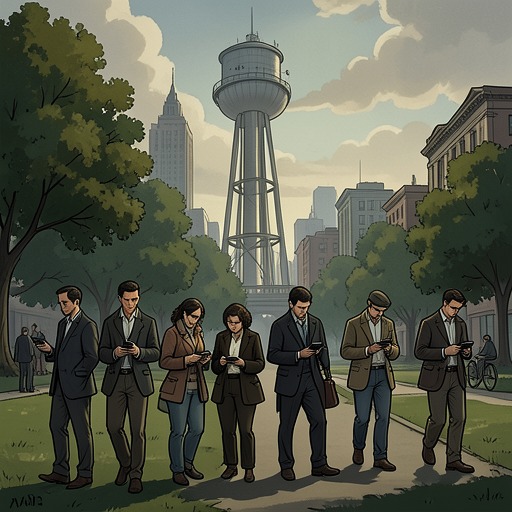
At the opening of the Irvington sequence, Matt mutters about a camera phone and looks up, but the towering object above him is an enormous beer bottle. At 185 feet, it dominates the skyline and is visible as a familiar landmark whenever he leaves his sagging two-family home. The structure once served as a water tower for the Pabst Blue Ribbon brewery, which left the area in 1985. Its copper-plated steel, glossy enamel, and gold stopper once made it a civic spectacle, illuminated at night for miles around. Now its surface has turned rust red, and its label has disappeared.
The loss of the label connects the bottle’s deterioration to the neighborhood around it. The surrounding district has not collapsed all at once; it has slowly disintegrated. That gradual decline is important to the setting’s character. The bottle remains conspicuous, but its former polish and public grandeur have drained away, leaving a landmark that records what has departed as clearly as what remains. Matt sees it so often that it belongs to the daily landscape rather than standing apart as a monument.
Matt’s Post-Prison Home
Matt began renting in Irvington nine years before the events described, despite his family’s protests. When he was newly out of prison, he felt he deserved no better; limited means made the choice practical as well as emotionally legible. He could not yet return to suburban life. For him, moving there too quickly would have been like ascending too fast from a dive: a change his body and sense of self were not ready to absorb. The narrative does not reduce his residence to a simple expression of guilt. Matt knows the causes are less straightforward, even if he cannot offer a better explanation than the difficulty of making that transition.
Over time, the locality’s everyday details become a form of home. Matt’s familiar circuit includes a Shell gas station, an old hardware store, a corner deli, people drinking on cracked sidewalks, routes leading toward Newark Airport, and a tavern hidden near the former brewery. These are not signs that the neighborhood has become prosperous or safe; they are the particular surroundings in which his life has taken shape. The city’s worn routine gives him a place to remain while he adjusts to a life beyond prison.
Domestic Life and Unequal Landscapes
When Olivia Hunter moves from Virginia to join Matt, he expects her to want a better neighborhood. Her background is different: she grew up in the small town of Northways, Virginia, and was raised by her father after her mother left when she was a toddler. Yet Irvington is where the couple lives, in a declining two-family building held together by aluminum siding. They occupy the right side; the Owens family of five lives on the left. Each side has two bedrooms and one and a half bathrooms, a compact domestic arrangement that places two households within the same deteriorating structure.
The city’s neglect becomes especially visible during a period of severe drought. After three weeks without East Coast rainfall, the already sparse grass beside Matt and Olivia’s home has nearly died. The contrast with Livingston is pointed: there, the condition of a lush lawn is treated as a matter of neighborhood concern, while in Irvington the brown grass attracts no attention. Matt’s blunt recognition that lawns are a rich man’s game turns a small detail of the landscape into a measure of unequal resources. What reads as a failure of upkeep in one place is, in another, an ordinary condition no one can afford to treat as a crisis.
A City Remembered and Abandoned
Irvington sits close to Newark, whose decline troubles Matt because he remembers it as a thriving community. As a child, he played tennis near Branch Brook Park and competed seriously enough to be ranked in the boys’ fourteen-and-under division; his parents drove him to tournaments in Port Washington every other weekend. The family stopped coming to the area before that period of competitive tennis had fully run its course. The distance between that childhood landscape and the neglected city of his adult life gives the setting a personal history as well as a social one.
Matt attributes Newark’s abandonment in part to the movement of wealthier residents to the suburbs during the 1950s and 1960s, and in part to the late-1960s riots and racism. He also senses that these explanations do not exhaust what happened, though he cannot name the additional cause. That uncertainty keeps his recollection from becoming a tidy account of urban decline. The surrounding region is shaped by departure, but the story also shows how departure becomes material: in the rusted tower, the deteriorating homes, the dead lawns, and the everyday routes that remain for the people who still live there.
Significance in the Narrative
Irvington’s role is grounded in contrasts between past and present, suburban standards and urban constraints, and a home that is materially poor but increasingly familiar. Matt’s decision to stay there reflects the slow, uneven pace of returning to life after prison; his surroundings do not resolve that difficulty, but make it visible. The bottle is at once a practical landmark and a remnant of the neighborhood’s former industrial presence, while the domestic setting locates the couple within a community that receives little attention from those who have left.
The place also resists an easy moral reading. Matt’s residence is not presented as proof that he has settled the question of what he deserves, and the book explicitly complicates guilt as an explanation for his choices. Instead, Irvington becomes the ground on which he can live while change remains gradual. Its decayed landmarks and routine streets register both deprivation and attachment: a home shaped less by an ideal destination than by the limits of what Matt can yet leave behind or return to.